
FAC200
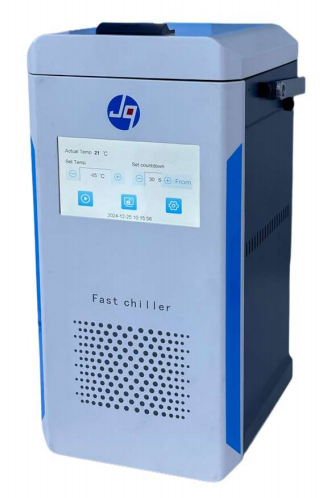
Fast Chiller

Product Overview:
Ultra-Low Temperature Freezing System for Rapid Frozen Block Preparation
• The FAC200 Fast Chiller is an ultra-low temperature freezing system designed to replace traditional dry ice and liquid nitrogen methods in frozen section preparation. Using Stirling cooler technology and an environmentally friendly, non-toxic coolant, the FAC200 enables rapid, uniform freezing of tissue specimens with minimal ice-crystal artifacts.
• As a functional equivalent to the PINO system, the FAC200 supports the same clinical workflow needs—fast frozen block preparation, consistent freezing quality, and convenient placement next to the cryostat. It is ideal for pathology departments, frozen section rooms, and high-throughput diagnostic laboratories.
Compact Design for Efficient Frozen Block Preparation
• Simply set the target temperature, allow the coolant to reach the desired level, and immerse the tissue using the supplied carrier. The FAC200 maintains temperatures down to –80°C, enabling rapid freezing in as fast as 30 seconds, depending on tissue size and thickness.
• No dry ice.
• No liquid nitrogen.
• No hazardous reagents.
• Just fast, clean, consistent freezing.
Environmentally Friendly Stirling Cooling System
• The FAC200 adopts a high-efficiency Stirling cooler module, delivering ultra-low temperatures with minimal energy
consumption. The system uses a self-developed, non-toxic coolant that is safe for operators and environmentally friendly.
• Compared with conventional dry ice/acetone or LN₂ methods, the FAC200 provides:
• Faster cooling
• More stable temperature control
• No hazardous consumables
• Lower operating cost
Rapid, Even Freezing for High-Quality Frozen Blocks
• The FAC200 freezes tissue evenly from all sides, minimizing the time spent in the 0°C to –7°C ice-crystal formation zone, which helps reduce freezing artifacts and preserves tissue morphology.
• No ice-crystal artifacts
• Suitable for fatty tissues
• Produces flat, planar frozen blocks
• Reduces trimming time inside the cryostat
These advantages support smoother, stress-free frozen sectioning and improved diagnostic quality.